The Lag and Why AI Displacement Numbers Tell Half the Story
Like my posts? Found something useful? Saved you some time? Buy me a coffee
There’s a narrative forming that goes something like this: AI is destroying white collar jobs, the economy is crumbling, and we’re all doomed. The numbers look terrifying. Nearly 700,000 job cuts in the first five months of 2025 alone, an 80% jump from the prior year [1]. College graduate unemployment hit 5.8% in March, the highest in over four years, and for the first time in modern history it’s trending above the aggregate rate [2]. Computer science graduates now face 6.1% unemployment, nearly double the rate of philosophy majors [3]. The irony there is almost too perfect.
But here’s the thing. This narrative, while grounded in real data, is missing the second half of the equation. And that second half is where it gets interesting.
What the Displacement Data Actually Shows
Let’s not sugarcoat what’s happening. The Federal Reserve Bank of St. Louis published research in August 2025 showing a striking correlation between AI exposure and unemployment increases. Occupations with the highest AI exposure, particularly computer and mathematical roles, saw the steepest rises in unemployment between 2022 and 2025. The correlation coefficient between AI adoption intensity and unemployment change was 0.57 [4]. That’s not noise. That’s signal.
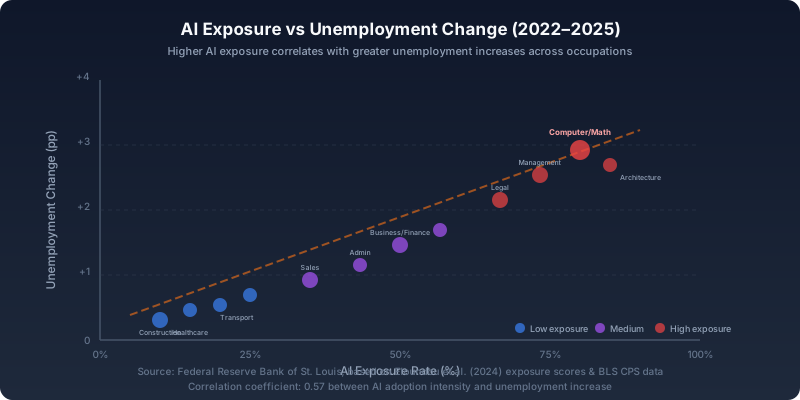 Data derived from the Federal Reserve Bank of St. Louis analysis, using Eloundou et al. (2024) AI exposure scores and Bureau of Labor Statistics data.
Anthropic’s own CEO, Dario Amodei, warned that AI could eliminate half of all entry-level white collar jobs and push unemployment to 10-20% within five years [5]. Ford’s CEO Jim Farley said AI will halve the number of white collar workers [6]. These aren’t fringe predictions. These are people building and deploying this technology.
But displacement is only Column 1 of a much wider spreadsheet.
We’ve Seen This Film Before
Every major technological revolution follows the same arc: displacement, panic, lag, creation. Every single time. And every single time, the lag period generates the most hand-wringing because destruction is immediate and visible, while creation is slow and diffuse.
During the first Industrial Revolution, real wages in Britain stayed flat for roughly 40 years while productivity soared. Economists call this “Engels’ pause.” The steam engine was invented, factories replaced artisans, and for decades it looked like the working class would never recover. They did. New industries, trade routes, and entire categories of work emerged that were literally unimaginable before the disruption [7].
Electrification followed a similar pattern. The electrical age began in the 1880s, but it took until the 1920s, nearly four decades, before electrification drove meaningful productivity gains [8]. The personal computer arrived in the 1970s, but the productivity boom didn’t materialise until the mid-1990s. Robert Solow famously quipped in 1987 that “you can see the computer age everywhere but in the productivity statistics.” That delay is now called the Solow Paradox [8].
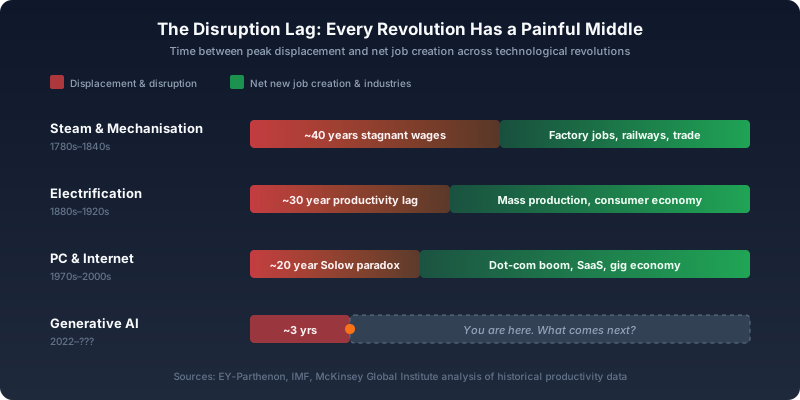 The pattern repeats. The lag between displacement and creation has shortened with each revolution, but it never disappears.
The pattern is consistent. And critically, the lag has shortened with each successive revolution. Steam took 40 years. Electricity took 30. The internet took roughly 20. If the trend holds, the AI lag could be measured in years, not decades. We might be three years in already.
The Entrepreneurship Signal Nobody’s Talking About
While the displacement headlines dominate, something remarkable is happening underneath. The US Census Bureau’s Business Formation Statistics tell a story that almost nobody in the AI doom narrative bothers to mention.
From 2005 to 2019, the US saw roughly 2.5 to 3.2 million new business applications per year. In 2020, that jumped to 4.35 million. In 2023, it hit a record 5.48 million. That’s not a blip. That’s a 70%+ sustained increase above pre-pandemic levels, and it shows no sign of reverting to baseline [9]. January 2026 saw 532,319 applications, a 7.2% increase over December 2025 [10].
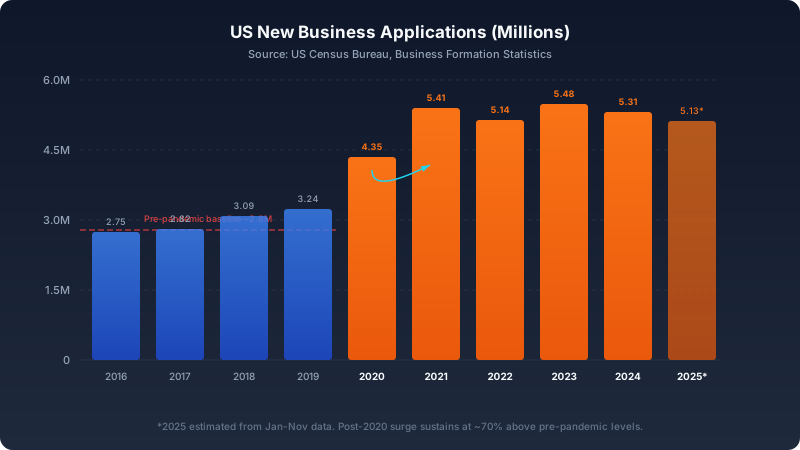 The post-2020 entrepreneurship surge has sustained for five years and shows no signs of normalising to pre-pandemic levels.
Nineteen percent of US adults now identify as entrepreneurs, the highest level ever recorded. Globally, 92% of economies saw an increase in new business formation in the most recent GEM survey period [11]. And critically, more than 20% of these new businesses are already using generative AI in their operations [12].
This matters because AI has fundamentally changed the economics of starting a company. Things that required a team of ten now require a team of one. A solo founder can build an MVP, handle marketing copy, generate legal documents, manage accounting, and ship a product without hiring anyone. Lovable, a European AI startup, went from launch to $17 million ARR in three months with just 15 people [13]. That ratio was physically impossible five years ago.
The EU picture tells a similar story. European AI startups secured 55% more year-on-year investment in Q1 2025 [14]. Over 4,100 AI startups now operate within the EU, with a combined enterprise value of €161 billion, a sixteen-fold increase over ten years [15]. Nearly half of all new unicorns globally are AI-driven [14].
The Career Transition Lag
There’s a second form of lag that’s equally important and equally invisible in the data: career transition time.
Most career changers land a new role within 6 to 12 months [16]. For those requiring significant reskilling, the timeline stretches further. The World Economic Forum estimates that 40% of workers will need reskilling of six months or less, while the overall reskilling challenge involves roughly 50% of all employees by the end of this decade [17].
This matters because a displaced financial analyst who spends eight months retraining as an AI-augmented product manager doesn’t show up in any “jobs created by AI” statistic during that transition. They show up as unemployed. They show up in the scary headlines. And then they quietly reappear in a new role, and nobody writes a breathless article about it.
The data bears this out. 80% of career changers report being happier in their new field, and 77% report earning the same or more within two years [16]. The transition works. It just takes time. And time, in aggregate, looks like a crisis.
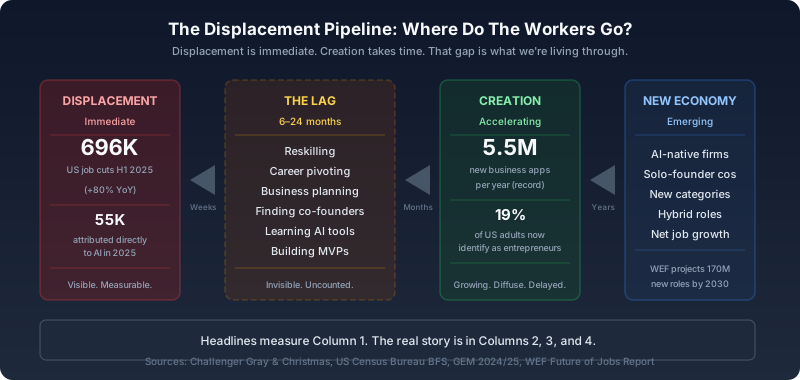 Headlines measure the first column. The real story unfolds across all four.
What We’re Actually Living Through
Here’s my read on the situation. We’re in the lag. Right in the thick of it. The displacement is real, it’s measurable, and for the people experiencing it, it’s genuinely painful. I don’t want to minimise that.
But we’re also in the early innings of what could be the largest entrepreneurial wave in history. The tools now exist for anyone with domain expertise and an idea to build something that would have required venture funding and a full engineering team five years ago. The barriers to company creation haven’t just lowered. For many categories of business, they’ve effectively vanished.
The question isn’t whether AI will create new industries, companies, and roles. History is unambiguous on this point. It always does. The question is how long the painful middle lasts, and what we do to shorten it.
The data suggests the lag is already compressing. Business formation numbers haven’t dipped. AI tool adoption among new businesses is accelerating. The career transition infrastructure, while imperfect, exists. And unlike previous revolutions, the very technology causing the displacement is simultaneously the most powerful tool available for building what comes next.
We’re not witnessing the end of work. We’re witnessing the messy, uncomfortable, statistically terrifying middle of a transition. And if you’re a white collar worker who just got displaced, you’re not standing at the edge of a cliff. You’re standing at the start of a lag. A lag that, for the first time in history, comes with an AI co-founder in your pocket.
The fire is real. But so is what gets built from the ashes.
References
[1] Challenger, Gray & Christmas, via FinalRoundAI, “12 White-Collar Jobs Most at Risk from AI in 2025,” 2025. https://www.finalroundai.com/blog/white-collar-jobs-most-at-risk-from-ai-in-2025
[2] J.P. Morgan Global Research, “AI’s Impact on Job Growth,” 2025. https://www.jpmorgan.com/insights/global-research/artificial-intelligence/ai-impact-job-growth
[3] FinalRoundAI analysis of BLS data, 2025. https://www.finalroundai.com/blog/white-collar-jobs-most-at-risk-from-ai-in-2025
[4] Ozkan, S. and Sullivan, N., “Is AI Contributing to Rising Unemployment? Evidence from Occupational Variation,” Federal Reserve Bank of St. Louis, August 2025. https://www.stlouisfed.org/on-the-economy/2025/aug/is-ai-contributing-unemployment-evidence-occupational-variation
[5] Axios, “AI jobs danger: Sleepwalking into a white-collar bloodbath,” May 2025. https://www.axios.com/2025/05/28/ai-jobs-white-collar-unemployment-anthropic
[6] CNBC, “AI is already taking white-collar jobs,” October 2025. https://www.cnbc.com/2025/10/22/ai-taking-white-collar-jobs-economists-warn-much-more-in-the-tank.html
[7] IMF Finance & Development, “A New Industrial Revolution?” December 2025. https://www.imf.org/en/publications/fandd/issues/2025/12/a-new-industrial-revolution-niall-kishtainy
[8] EY-Parthenon, “Tech disruptions can inform the economic impact of AI,” October 2025. https://www.ey.com/en_gl/insights/ai/tech-disruptions-can-inform-the-economic-impact-of-ai
[9] Commerce Institute analysis of US Census Bureau BFS data, January 2026. https://www.commerceinstitute.com/new-businesses-started-every-year/
[10] US Census Bureau, “Business Formation Statistics, January 2026,” February 2026. https://www.census.gov/econ/bfs/current/index.html
[11] Global Entrepreneurship Monitor 2024/2025, via PrometAI, December 2025. https://prometai.app/blog/global-entrepreneurship-trends-ai-2025
[12] Gusto, “2024 New Business Formation Report,” 2024. https://gusto.com/resources/gusto-insights/new-business-formation-report-2024
[13] Paul Cheek, “AI-Driven Enterprises: How AI is Redefining Innovation-Driven Enterprises,” June 2025. https://www.paulcheek.com/articles/ai-driven-enterprises
[14] EU-Startups, “The AI uprising: 20 European AI startups to watch in 2025,” May 2025. https://www.eu-startups.com/2025/05/the-ai-uprising-20-european-startups-rewriting-the-rules-in-2025/
[15] European Commission, “Supporting the Apply AI strategy: AI Start up and investment activity,” 2025. https://digital-strategy.ec.europa.eu/en/library/supporting-apply-ai-strategy-ai-start-and-investment-activity-across-10-key-industrial-sectors
[16] Apollo Technical, “27 Remarkable Career Change Statistics,” February 2025. https://www.apollotechnical.com/career-change-statistics/
[17] World Economic Forum, “Future of Jobs Report 2023” and “Unlocking Opportunity,” 2024. https://www.weforum.org/stories/2024/09/global-job-market-changing-opportunity-jobs-transition/