The AI Divide How Frontier Models Risk Becoming the Rich Person's Superpower
Like my posts? Found something useful? Saved you some time? Buy me a coffee
The productivity gains from frontier AI models are real. Not theoretical, not projected, not “emerging.” Real. I use Claude, GPT, and Gemini daily in my platform engineering work, and the output multiplier is staggering. Tasks that used to take me a full afternoon now take twenty minutes. Architecture documents, Terraform modules, debugging complex Aurora PostgreSQL cluster issues, writing RFCs. The leverage is unlike anything I’ve experienced in eighteen years of building software.
And that’s the problem.
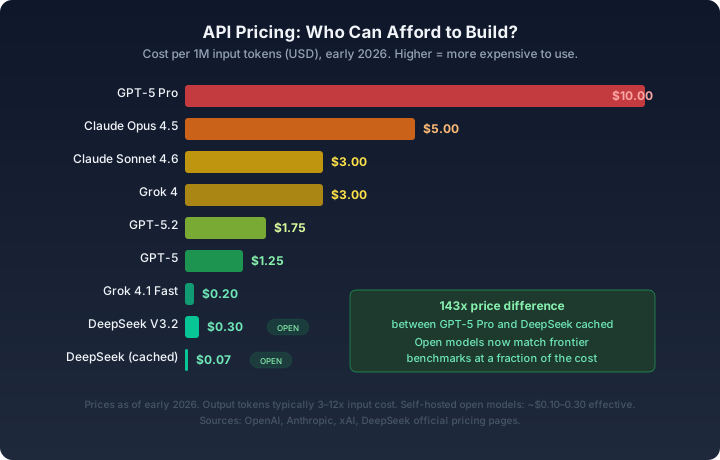
Because right now, the best of that leverage costs money. Not trivial money either. A Claude Pro subscription, a ChatGPT Plus plan, a GitHub Copilot seat. Stack those up and you’re north of £50 a month before you’ve even touched the API. The Pro tiers? ChatGPT Pro runs $200 a month. Want to run frontier models through the API for anything non-trivial? Budget accordingly. The 2025 pricing data tells its own story. Claude Opus 4.5 sits at $5 per million input tokens, Grok 4 and Claude Sonnet at $3, while GPT-5 Pro commands $10 with output tokens running to a staggering $120 per million. The subscription tiers are even more telling: ChatGPT Pro at $200 a month, Claude Max at $100–200, xAI's SuperGrok Heavy at $300. These aren’t numbers that everyone can absorb casually.
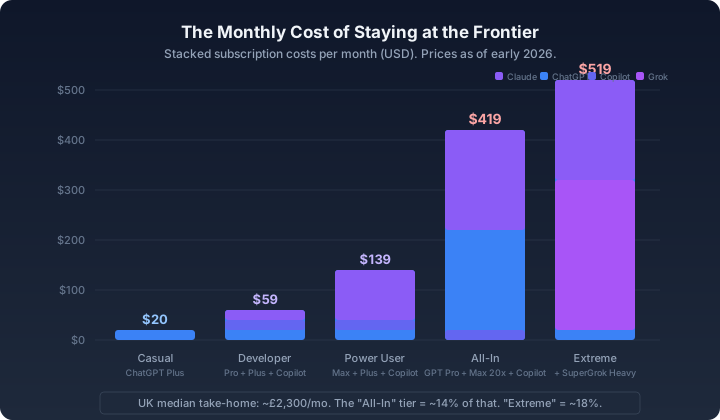
This matters because we’re not talking about a nicer phone or a faster car. We’re talking about a genuine cognitive multiplier. A tool that makes you measurably better at your job, faster at learning, more capable of operating independently. When that tool is gated behind a paywall, you’ve created a feedback loop: the people who can afford AI get more productive, earn more, and can afford better AI. The people who can’t, fall further behind.
The “But the Rich Could Always Hire People” Argument
I’ve seen this counterargument surface repeatedly, and it’s worth engaging with honestly. Yes, wealth has always bought leverage. A CEO could always hire ten engineers. A wealthy individual could always pay consultants, lawyers, accountants to operate on their behalf. Capital has always purchased human labour, and that has always created inequality.
But there’s a meaningful difference here. Human labour doesn’t scale the way AI does. Hiring ten people means managing ten people, with all the coordination overhead, communication loss, and diminishing returns that come with it. Anyone who’s worked in a 30-person engineering org knows this intimately. Adding headcount does not linearly increase output. Often it decreases it.
AI scales differently. A $20 per month subscription gives you access to a model that can context-switch between infrastructure architecture and legal contract review and market analysis without blinking. It doesn’t need onboarding. It doesn’t have a notice period. It doesn’t get tired at 4pm on a Friday. The leverage-per-pound ratio is orders of magnitude higher than hiring humans. That’s what makes this different from every previous wealth advantage. The gap between “can afford it” and “can’t” translates into a much larger capability gap than it ever did with human labour.
The Harness Gap Nobody Talks About
Raw model capability is only half the story. The other half, arguably the more important half, is the harness. The tooling, the integrations, the product design that makes a model actually useful to a human being.
Take Claude Code as an example. It’s a command-line tool that lets you delegate coding tasks to Claude directly from your terminal. Brilliant product. But it requires a paid API plan or a Max subscription. The free tier of most AI products is deliberately hobbled: rate limits, model downgrades after a handful of messages, no access to the latest reasoning modes. These aren’t technical limitations. They’re business decisions. And they mean the gap between the free and paid experience is enormous.
This is where the analogy to other technology revolutions falls apart. When the internet arrived, a library computer gave you the same Google as a home broadband connection, just slower. The quality of the tool was the same. With AI, the free tier and the paid tier aren’t the same tool at different speeds. They’re fundamentally different experiences. A free-tier model falling back to a lightweight variant after a handful of messages versus a $200/month Pro subscription with frontier reasoning, 2 million token context windows, and chain-of-thought? Those aren’t two flavours of the same thing.
Open Weight Models: The Best Hope We’ve Got
Here’s where the picture gets more encouraging, and where I’ll push back against my own pessimism.
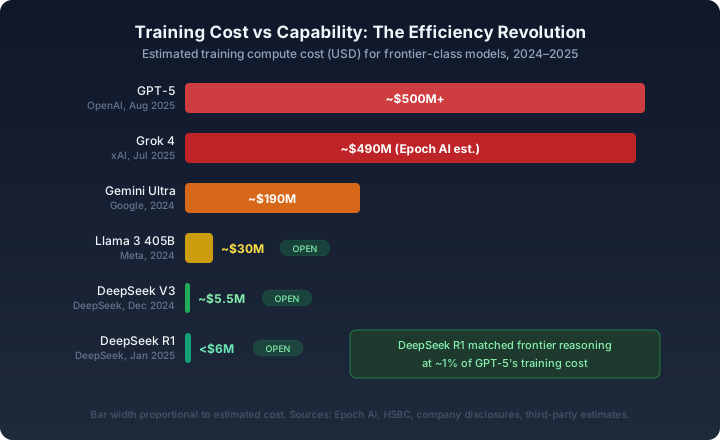
The open-weight model ecosystem had a genuinely transformative year in 2025. DeepSeek R1 landed in January, a reasoning model reportedly trained for under $6 million that matched OpenAI's o1 on key benchmarks. For context, GPT-5's training runs are estimated at $500 million or more, and Grok 4 cost xAI roughly $490 million according to Epoch AI. That’s not a marginal efficiency gain. That’s a paradigm shift.
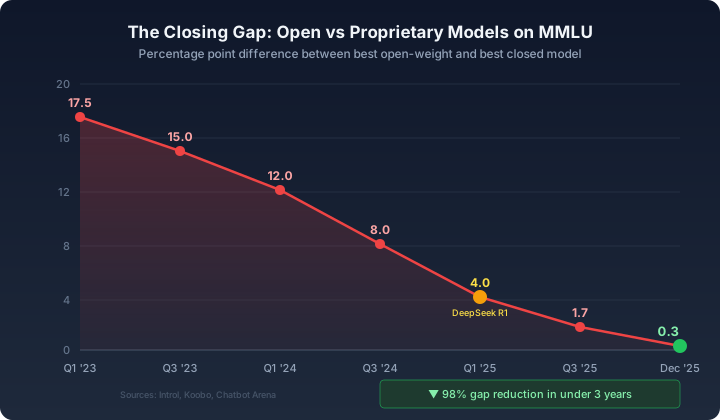
The numbers since then have been remarkable. On MMLU, the standard benchmark for broad knowledge, the gap between the best open and proprietary models shrank from 17.5 percentage points to 0.3 in a single year.
Alibaba’s Qwen3-235B matches or beats GPT-4o on most public benchmarks while activating only 22 billion of its 235 billion parameters per inference pass. Meta’s Llama 4 Scout ships with a 10 million token context window and runs on a single H100 GPU. DeepSeek V3.2 achieves parity with GPT-5 across multiple reasoning benchmarks, activating just 37 billion of its 671 billion parameters per token. Qwen3 scores 92 out of 100 on AIME 2025, outperforming OpenAI’s o3 on advanced maths using only 22 billion active parameters.
These models can be downloaded. They can be run locally. Tools like Ollama and LM Studio make it possible to run capable models on consumer hardware. Not the absolute frontier, but genuinely useful models. A developer with a decent GPU can now run a reasoning model locally that would have been considered state-of-the-art eighteen months ago.
This is the counterweight. This is what stops the paywall problem from becoming permanent.
But It’s Not Enough Yet
Let’s be honest about the limitations. Running a 70 billion parameter model locally requires hardware that most people don’t have. You need a GPU with serious VRAM, ideally 24GB or more for comfortable inference at reasonable context lengths. That’s a £1,000+ graphics card in a £2,000+ machine. Better than $200 a month in subscriptions over time, sure, but still a significant upfront barrier.
And the harness gap remains. Open-weight models give you raw capability, but building the tooling around them to make them genuinely useful? That still requires technical knowledge that most people don’t have. The gap between “download Llama 4 and run it in a terminal” and “have a polished AI assistant integrated into your workflow” is vast.
The real democratisation happens when these models are served cheaply through hosted platforms. DeepSeek’s API pricing sits at $0.30 per million tokens, dropping to as low as $0.07 with cache hits. That’s 143 times cheaper than GPT-5 Pro. Chinese labs and xAI’s aggressive Grok 4.1 Fast pricing at $0.20 per million input tokens are driving price competition that’s pulling the entire market downward.
So What Actually Needs to Happen
The open-weight community is doing the heavy lifting right now, and it needs to keep doing it. Every Qwen release, every DeepSeek paper published with full training methodology, every Llama model shipped under a permissive license chips away at the moat.
But models alone aren’t sufficient. We need the harness to be open too. Open-source toolchains for deployment, fine-tuning, and integration. Projects like Hugging Face’s ecosystem, vLLM for inference, and the broader MLOps community are critical infrastructure for making open models actually usable by people who aren’t ML engineers.
Governments have a role to play as well. If AI genuinely becomes the productivity multiplier it appears to be, then treating access to capable AI as a public good isn’t radical. It’s pragmatic. Just as we decided that internet access, education, and healthcare shouldn’t be purely market-allocated, there’s an argument for ensuring that baseline AI capability is available to everyone.
The cynical read is that this is just another play where the billionaires extract value. Build the models, create dependency, then charge rent. And to be fair, that’s exactly the playbook we’ve seen with cloud computing, social media, and most of the modern tech stack. The optimistic read is that the open-source community, turbocharged by contributions from Chinese labs operating under different incentive structures, keeps the pressure on.
Time will tell which read is correct. But if you care about this, the most concrete thing you can do right now is use open models, contribute to open tooling, and refuse to accept that cognitive superpowers should be a luxury good.
The future of AI shouldn’t be determined by your credit card limit.